Rayan Farouk
Insurance billing has become one of the most important operational functions within modern healthcare facilities. Whether you run a dental clinic, medical center, polyclinic, physiotherapy center, dermatology clinic, or multi-specialty hospital, your ability to submit accurate insurance claims directly impacts your revenue cycle, cash flow, and overall profitability.
In the UAE healthcare sector, electronic claim submission has replaced traditional paper-based processes. Clinics are now expected to submit insurance claims electronically while complying with strict regulatory and payer requirements. As a result, healthcare providers often encounter two terms that appear similar but actually serve very different purposes: eClaims and eClaimLink.
Many clinic owners and administrators mistakenly assume that these terms refer to competing systems or alternative methods of claim submission. Others believe that eClaimLink itself generates claims or replaces practice management software. These misunderstandings can create confusion when selecting healthcare software, planning clinic operations, or implementing insurance workflows.
The reality is much simpler.
eClaims and eClaimLink are not competitors. They are different components of the same insurance billing process. One refers to the claim itself, while the other refers to a platform used to transmit and exchange claims.
Understanding this distinction can help your clinic:
- Improve claim acceptance rates
- Reduce insurance rejections
- Accelerate reimbursement timelines
- Simplify billing operations
- Ensure regulatory compliance
- Improve overall revenue cycle management
In this guide, we will explore what eClaims are, what eClaimLink does, how they work together, common misconceptions, the benefits of integrated healthcare software, and how to determine the right solution for your clinic.
Understanding Electronic Claims in Healthcare
Before discussing eClaimLink, it is important to understand what an electronic claim actually is.
An electronic claim, commonly referred to as an eClaim, is a digital representation of a healthcare service provided to an insured patient.
When a patient visits a clinic and receives treatment, the healthcare provider records all relevant information. This information is then organized into a standardized claim format and submitted to the patient’s insurance company for reimbursement.
A typical electronic claim contains:
- Patient demographics
- Insurance details
- Policy information
- Provider details
- Visit information
- Diagnosis codes
- Procedure codes
- Treatment information
- Prescriptions
- Charges and fees
- Authorization details when applicable
The insurance company reviews the submitted claim and determines whether the treatment is covered under the patient’s policy. Once reviewed, the insurer either approves, partially approves, requests additional information, or rejects the claim.
Without electronic claims, healthcare providers would have to submit paperwork manually, resulting in slower processing times, increased administrative costs, and higher error rates. Today, electronic claims form the foundation of healthcare revenue cycle management throughout the UAE and around the world.

Why Electronic Claims Matter
Insurance claims are not simply administrative documents. They directly affect a clinic’s financial health. Every treatment provided to an insured patient generates potential revenue. However, that revenue is only collected when the claim is processed successfully.
Poor claim management can result in:
- Delayed payments
- Increased claim rejections
- Administrative burden
- Revenue leakage
- Staff inefficiency
- Poor patient experiences
Electronic claims help eliminate many of these challenges.
Benefits include:
Faster Processing
Claims can be transmitted instantly instead of being mailed or manually delivered.
Improved Accuracy
Automated systems validate information before submission, reducing human errors.
Better Tracking
Clinics can monitor claim status throughout the entire reimbursement cycle.
Reduced Operational Costs
Less paperwork means lower administrative expenses.
Faster Reimbursement
Claims that are submitted correctly are generally processed more quickly.
For these reasons, electronic claims have become the standard method of insurance billing across healthcare organizations.
What Is eClaimLink?
eClaimLink is a healthcare claims exchange platform that facilitates communication between healthcare providers and insurance companies.
Rather than each clinic creating separate technical connections to dozens of insurance companies, healthcare providers can submit claims through a centralized exchange platform.
The platform serves as an intermediary that receives claims from healthcare providers and routes them to the appropriate insurance payer.
In addition to routing claims, eClaimLink performs several important functions:
- Data validation
- Claim standardization
- Eligibility verification support
- Communication between providers and insurers
- Remittance processing
- Status updates and responses
The platform helps ensure that healthcare transactions follow approved standards and formats.
Instead of manually coordinating with multiple insurers individually, clinics can use a standardized workflow that simplifies claim submission and management.
Understanding the Difference: A Simple Analogy
One of the easiest ways to understand the relationship between eClaims and eClaimLink is to compare them to postal services. Imagine you are sending a package. The package itself contains the information you want to deliver. The courier service transports the package to its destination.
In this example:
- The package represents the eClaim.
- The courier service represents eClaimLink.
The claim contains the healthcare information. eClaimLink helps deliver that information to the insurance company. Without the claim, there is nothing to send. Without the transmission platform, the claim cannot reach the insurer efficiently. Both components are necessary, but they perform entirely different functions.
The Complete Insurance Claim Workflow
Many healthcare professionals only see a small portion of the billing process. To understand where eClaims and eClaimLink fit, let’s examine the complete workflow.
Step 1: Patient Registration
The patient arrives at the clinic.
Front desk staff collect:
- Emirates ID
- Insurance card
- Personal details
- Contact information
This information is entered into the clinic management system.

Step 2: Insurance Verification
The patient’s insurance coverage is verified.
Staff confirm:
- Eligibility
- Policy status
- Network participation
- Covered services
- Co-payment requirements
This step helps reduce future claim issues.
Step 3: Clinical Consultation
The healthcare provider examines the patient and documents:
- Symptoms
- Diagnoses
- Treatment plans
- Procedures
- Medications
Accurate clinical documentation is essential because insurance companies evaluate claims based on the information recorded by the provider.
Step 4: Coding
Clinical information is translated into standardized codes.
These may include:
- ICD diagnosis codes
- CPT procedure codes
- Dental treatment codes
- Service classifications
Coding accuracy significantly impacts claim approval rates.
Step 5: Claim Generation
The clinic software generates an electronic claim file.
The file includes all necessary information required by the insurer.
This generated file is the actual eClaim.
Step 6: Claim Validation
Before submission, the software checks for:
- Missing fields
- Invalid codes
- Incorrect patient data
- Authorization issues
- Duplicate claims
Validation helps identify errors before they reach the insurer.
Step 7: Claim Submission Through eClaimLink
The validated claim is submitted through eClaimLink.
The platform receives the claim and forwards it to the correct insurance company.
Step 8: Insurance Review
The insurer evaluates:
- Medical necessity
- Coverage eligibility
- Policy limitations
- Authorization requirements
- Billing accuracy
The claim is then approved, adjusted, or rejected.
Step 9: Remittance Response
The insurer sends a response.
The response may include:
- Approved amounts
- Denied services
- Adjustments
- Explanations
- Payment details
The information is returned through the exchange platform.
Step 10: Revenue Collection
The clinic records payment and follows up on any outstanding balances, denials, or resubmissions.
This completes the revenue cycle.
Common Misconceptions About eClaims and eClaimLink
Many clinics misunderstand the role of each system.
Let’s address some of the most common misconceptions.
Misconception #1: eClaimLink Creates Insurance Claims
This is incorrect.
eClaimLink does not create claims.
Your clinic management software creates the claim.
eClaimLink only receives and transmits it.
Misconception #2: eClaimLink Replaces Clinic Software
Also incorrect.
eClaimLink is not designed to manage:
- Appointments
- Medical records
- Clinical notes
- Billing
- Patient communication
A clinic still requires a healthcare management system.
Misconception #3: eClaims and eClaimLink Are Competitors
They are not competitors.
One is the claim itself.
The other is a transmission platform.
Both are required components of modern insurance billing.
Misconception #4: Small Clinics Don’t Need Proper Claim Management
Even small clinics process hundreds or thousands of claims annually.
Minor inefficiencies can quickly lead to significant financial losses.
A proper insurance workflow benefits clinics of every size.
Challenges Clinics Face Without Integrated Systems
Many healthcare providers still rely on disconnected workflows.
Examples include:
- Separate billing software
- External spreadsheets
- Manual claim tracking
- Repeated data entry
- Multiple login systems
These approaches create several problems.
Increased Human Error
Every additional manual step increases the risk of mistakes.
Slower Claim Submission
Staff spend more time entering and verifying data.
Higher Rejection Rates
Missing information and coding errors become more common.
Poor Visibility
Management cannot easily monitor claim performance.
Delayed Revenue
Rejected claims take longer to correct and resubmit.
Integrated healthcare systems solve many of these challenges
Benefits of Integrated eClaimLink Solutions
When eClaimLink functionality is built directly into clinic software, significant efficiencies can be achieved.
Faster Workflows
Information flows automatically from patient records to insurance claims.
Improved Accuracy
Clinical and billing data remain synchronized.
Reduced Administrative Burden
Staff avoid duplicate data entry.
Better Financial Visibility
Management can track:
- Revenue
- Outstanding claims
- Rejections
- Collections
Stronger Compliance
Integrated systems help maintain required data standards.
Improved Patient Experience
Faster claim processing can reduce delays and billing disputes.
Key Features to Look for in a Healthcare Billing System
When evaluating software for your clinic, focus on more than just claim submission.
A modern solution should include:
Electronic Medical Records
Complete patient documentation.
Appointment Scheduling
Efficient management of provider calendars.
Insurance Verification
Eligibility checking before treatment.
Automated Claim Generation
Creation of compliant electronic claims.
Claim Validation
Error detection before submission.
Rejection Management
Tools for identifying and correcting denied claims.
Financial Reporting
Revenue and billing insights.
Audit Trails
Tracking of changes and user activity.
Multi-Specialty Support
Flexibility across different healthcare disciplines.
Scalability
Ability to grow alongside the clinic.
How Better Claims Management Improves Revenue
Many clinics focus primarily on attracting new patients.
However, improving claim management can significantly increase revenue without acquiring a single additional patient.
For example:
If a clinic submits 3,000 claims per month and reduces its rejection rate from 12% to 5%, the impact can be substantial.
Benefits may include:
- Faster payments
- Reduced write-offs
- Lower administrative costs
- Improved cash flow
- Increased profitability
Revenue cycle optimization often produces one of the highest returns on investment for healthcare providers.
Which Solution Should Your Clinic Use?
The answer depends on your goals.
If you are asking whether your clinic should choose eClaims or eClaimLink, the reality is that you typically need both.
Your clinic needs:
- A healthcare management system capable of generating compliant electronic claims.
- A claim exchange mechanism that allows those claims to reach insurance companies efficiently.
The most effective approach is to implement a solution that combines:
- Clinical operations
- Billing workflows
- Insurance management
- Claims processing
- Reporting tools
within a single platform.
This reduces complexity while improving operational efficiency.
How Balsam Medico Helps Clinics Manage Insurance Claims
Healthcare providers need more than claim submission tools. They need a complete operational platform.
Balsam Medico helps clinics manage:
- Patient records
- Appointment scheduling
- Treatment documentation
- Billing workflows
- Insurance management
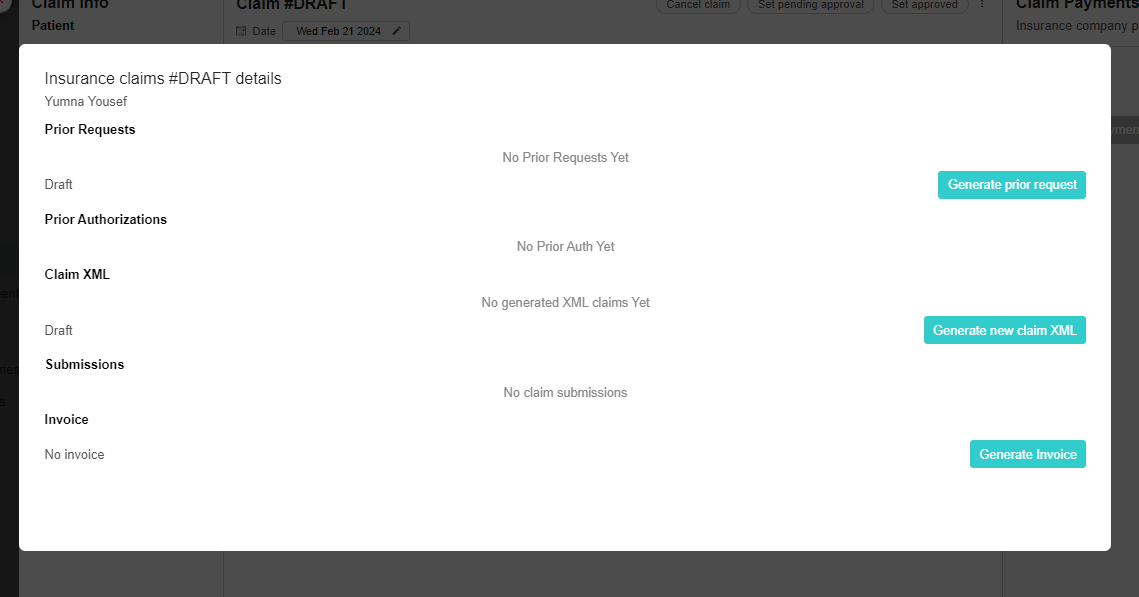
- Claims preparation
- Claim exports
- Financial reporting
- Operational analytics
By bringing clinical and administrative processes together, clinics can improve accuracy, reduce manual work, and maintain better control over their revenue cycle.
Instead of relying on disconnected systems, staff can work from a centralized platform designed specifically for healthcare operations.
Final Thoughts
The discussion should not be framed as “eClaims versus eClaimLink.”
They serve different purposes.
eClaims are the electronic insurance claims generated from patient visits and treatments.
eClaimLink is a platform that facilitates the exchange of those claims between healthcare providers and insurance companies.
Understanding this distinction helps clinics make smarter technology decisions, improve billing performance, and streamline insurance operations.
As healthcare becomes increasingly digital, successful clinics will be those that integrate clinical care, insurance billing, and revenue cycle management into a unified workflow.
Whether you operate a single-provider practice or a multi-location healthcare organization, investing in efficient electronic claim management can reduce administrative burden, improve reimbursement speed, strengthen compliance, and ultimately support sustainable clinic growth.
Connect with Us
Ready to embark on this exciting journey? Contact us today:
📍 Dubai, United Arab Emirates – Tel: +971 56 640 9602
📍 Khartoum, Sudan – Tel: +249 91 273 1048Explore Balsam Medico and discover a world of efficient clinic management at www.balsammedico.com. Together, let’s reduce fines, elevate efficiency, and embrace a new era of dental healthcare.
One last thing..
PS: We built Balsam Medico to be the best software for clinics in UAE and the middle east. It is powerful, flexible, and most importantly, very easy to use.
If you have two minutes, see how it works.
This is the main landing page to learn more.