Rayan Farouk
Every dental assistant, front desk coordinator, and practice manager knows the feeling. A dentist reaches for a specific shade of composite and it isn’t there. Or the anesthetic cartridges in the drawer turn out to be a batch that expired last month. Or the supply room is so full of boxes that nobody can find the item they actually need. Inventory problems don’t feel like “business problems” when you’re the one dealing with them. They feel like a delayed patient, an awkward apology, and a scramble to fix something that should have been caught days earlier.
The good news is that most dental inventory problems come down to a handful of habits, not a complicated system. This piece walks through why supplies run out or pile up in the first place, and the simple, practical steps clinic staff in the UAE use to keep the shelves in good shape without it becoming a full-time job.
Why This Is Trickier Than It Sounds
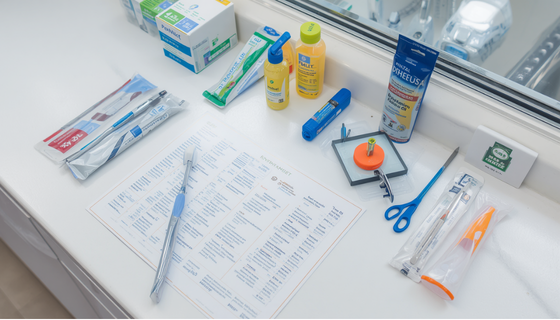
Managing dental supplies sounds simple on the surface: know what you have, know what you’re using, order more before you run out. In practice, a few things make it harder than that.
There’s a lot to keep track of
A typical clinic stocks anywhere from 200 to 500 different items once you count every shade, size, and brand separately. Some things, like gloves, cotton rolls, and anesthetic cartridges, get used constantly. Others, like a specific implant part or a rarely used medicine, might only get used a few times a year. Treating all of these the same way is how clinics end up both overstocked and understocked at the same time.
Orders take time to arrive
Many dental materials used in UAE clinics are imported. That means a shipment has to travel, clear customs, and go through a local distributor before it reaches the clinic. Most of the time this takes a predictable few days. But it can stretch out around public holidays, shipping delays, or a supplier running low on their own stock. If you’re used to a three-day wait and it suddenly becomes a week, that gap is exactly when a stockout happens.
A lot of it expires
Bonding agents, anesthetics, impression materials, and other everyday supplies all have expiry dates and sometimes specific storage needs. Order too much of something and it’s easy to end up throwing away a chunk of it a year later because it expired before anyone used it. That’s an important thing to remember: ordering extra “just in case” isn’t automatically the safe choice. It just moves the risk from a stockout to a write-off.
Multiple branches make it more complicated
If a clinic group has more than one location, each branch usually has its own pattern of what gets used and how fast. A branch that’s quieter on weekdays and a branch that’s busier on weekends won’t need the same stock levels. Ordering the same amount for every branch usually means one location runs short while another sits on excess stock.
Demand changes with the seasons
Patient numbers aren’t the same all year. Summer tends to be quieter as people travel, while the months after summer and the end of the year often get busier as patients use up their remaining insurance benefits. If ordering habits don’t shift with these patterns, clinics end up overstocked heading into a slow period or underprepared heading into a busy one.
The main thing to remember: running out of stock and having too much stock are usually caused by the same root problem, ordering based on habit or guesswork instead of what’s actually being used and what’s actually on the shelf.
What a Stockout Really Costs
A missing item can seem like a small hiccup, a quick call to the supplier, a slightly awkward moment with the patient. But the cost adds up faster than it looks.
- Lost chair time. A dentist who discovers mid-procedure that something is missing either has to pause and improvise or reschedule the patient, and that booked time slot is gone for the day.
- Frustrated patients. Someone who had their appointment delayed or postponed because a supply wasn’t available is less likely to book again or recommend the clinic to a friend.
- Paying more to fix it fast. A rush order to cover a sudden shortage almost always costs more than a normal order, both in the price of the item and the delivery fee.
- Staff time spent firefighting. Every minute spent calling around for an emergency supply or rearranging the schedule is time not spent on patients.
- Treatment continuity issues. For a multi-visit case, like orthodontics or a staged restoration, running out of the specific material or brand already used partway through can force a change in plan mid-treatment.
What Overordering Really Costs

Overordering doesn’t create a dramatic moment the way a stockout does, which is exactly why it tends to go unnoticed for longer.
- Expired stock gets thrown away. Anything that passes its expiry date before it’s used is money that simply disappears, and this hits shorter shelf-life items like anesthetics and bonding agents hardest.
- Cash gets tied up on the shelf. Money spent on excess stock is money that isn’t available for new equipment, training, or simply having a healthy buffer in the bank.
- Storage becomes a problem. Space in a clinic is valuable. A supply room overflowing with excess stock is space that could be used for something else, or at minimum makes it harder to find what you actually need.
- Older stock becomes outdated. Dental products get updated and reformulated over time. A large batch bought in bulk can become obsolete before it’s used up.
- Ordering “just in case” becomes a habit. When staff can’t easily see how much stock is already on hand, the natural response is to order extra to be safe. Multiply that across dozens of items and several people placing orders, and that safety margin becomes a real cost.
Simple Habits That Keep Supplies on Track
Set a minimum and a “reorder now” line for every item
For every item in the supply room, it helps to know two numbers: how much you should always have on hand, and the point at which it’s time to reorder. High-use items like gloves and cotton rolls can have a simple, generous buffer. Lower-use, higher-cost, or slow-to-arrive items, like specific implant parts, deserve a closer eye and a named person who checks on them regularly.
Give your busiest, most critical items the most attention
Not every item deserves equal attention. A small number of items, usually the ones used constantly or the ones that are expensive or hard to replace quickly, matter far more than the rest. It’s worth knowing which items those are for your clinic and checking on them more often than you check on, say, spare stationery or low-cost disposables.
Use the oldest stock first
This is one of the simplest and most effective habits in the whole list: whenever new stock arrives, put it behind the existing stock on the shelf, not in front of it. That way, whatever is closest to its expiry date always gets used first. It costs nothing and prevents a surprising amount of waste.
Check real delivery times, not the times you assumed
If a supplier used to deliver in three days but has been taking six lately, it’s worth updating your reorder timing to match. Sticking with an old assumption about how fast an order will arrive is one of the most common reasons clinics get caught out.
Look at next week’s schedule before you order
The appointment book is one of the best tools for predicting what you’ll need. A week with several implant placements or new orthodontic starts has a predictable pull on specific materials. Glancing at what’s booked before placing a routine order can catch a shortage days before it would otherwise turn into a same-day emergency.
Have a backup supplier for your most important items
Relying on a single supplier for a critical item means a delay on their end becomes a delay for your clinic too. For the handful of items that really matter, it’s worth having a second, already-approved supplier you can turn to if the usual one falls through.
Do a physical count regularly, not just when something goes wrong
Even with a good tracking system, it’s easy for small mistakes to creep in: a delivery that wasn’t logged correctly, an item that was used but not recorded. A regular physical count, whether that’s everything once a quarter or the most important items more often, catches these errors before they turn into a real shortage or an inaccurate reorder alert.
Where the Right System Makes This Easier
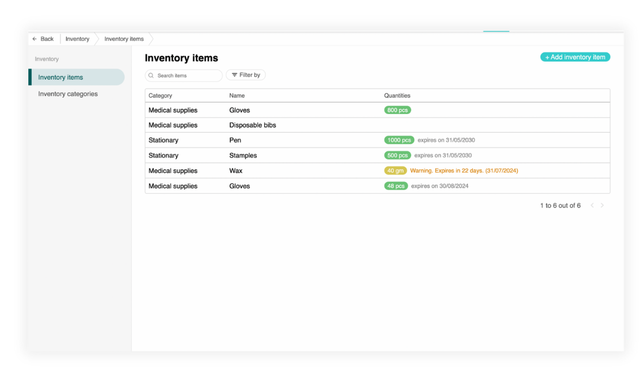
All of the habits above can be done with a notebook and a lot of discipline, but they get significantly easier with the right tools in place.
Seeing stock levels update automatically
When stock is deducted automatically as it’s used during a procedure, instead of relying on someone updating a spreadsheet later, staff are always looking at an accurate number instead of a guess.
Getting alerted before you run out
A system that flags an item as it nears its reorder point takes the pressure off staff having to remember to check every single line by hand, especially for the items that are used less often and easier to forget about.
Tracking expiry dates automatically
Recording batch numbers and expiry dates as stock comes in, and getting a heads-up as something nears its expiry, gives staff a chance to use it up or move it to where it’s needed before it becomes a write-off.
Seeing all branches in one place
For clinic groups with more than one location, being able to see stock levels across every branch in a single view makes it much easier to notice when one branch could use up stock that’s about to expire at another, instead of ordering more of the same thing twice.
Connecting the schedule and the supply room
Clinics using an integrated clinic management and EMR platform have an advantage here: the appointment schedule, treatment plans, and stock levels all live in the same place. That makes it possible to glance at what’s coming up and what’s on the shelf without switching between separate tools or spreadsheets.
A Few Habits to Build as a Team
- Make sure someone owns each category. Even with alerts in place, someone still needs to actually place the order when a notification comes in. Without a clear “this is your item to watch,” reorder alerts get missed.
- Revisit your minimum stock levels now, and then what a clinic used a year ago isn’t necessarily what it uses today. A quick review every few months keeps stock levels matched to how the clinic is actually running.
- Use expiry dates to plan ahead, not just to clean out old stock. If the same item keeps expiring before it’s used, that’s useful information. It usually means it’s being ordered in larger amounts than the clinic actually needs.
- Treat critical items differently from everyday ones. Running low on gloves is annoying. Running out of a specific implant part mid-case is a real problem for the patient and the clinic’s reputation. It’s fine to check on these two categories differently.
- Keep an eye on how suppliers are performing. If a supplier’s delivery times keep slipping, that’s worth noting and factoring into how early you place your next order with them.
A Simple Weekly Routine
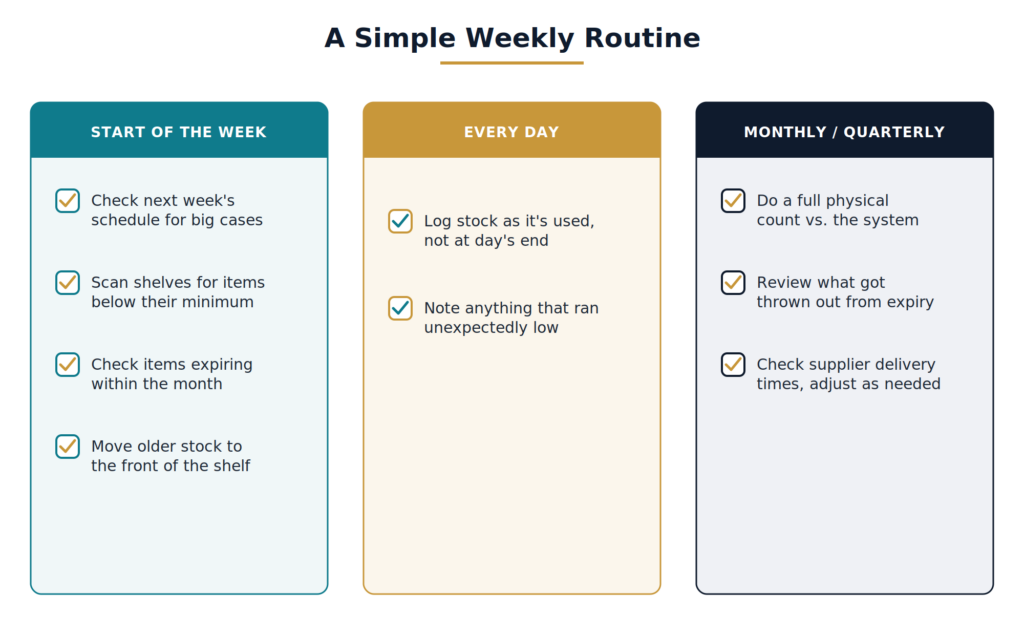
Most clinics don’t need a new system so much as a short, repeatable routine that everyone follows. Here’s a version that works well without taking up much time.
At the start of each week
- Glance at the appointment schedule for anything unusual, like several implant cases or a run of new orthodontic starts, and check that the related materials are in stock.
- Scan the shelves for anything below its minimum level and place orders for those items before they become urgent.
- Check for anything expiring in the next month and move it to the front so it gets used first.
Every day
- Log what’s used as it’s used, rather than waiting until the end of the day to update records from memory.
- Note anything that ran unexpectedly low, even if it didn’t cause a problem this time, so it can be reviewed at the next stock check.
Once a month or once a quarter
- Do a full physical count and compare it against what the system shows, correcting any mismatches.
- Look back at what was thrown away due to expiry and ask whether that item is simply being ordered in larger amounts than needed.
- Check in on supplier delivery times and adjust reorder timing for anyone who’s been running slower than usual.
None of these steps take long individually, but done consistently, they catch most problems while they’re still small and easy to fix, rather than after they’ve turned into a missing item mid-appointment or a bin full of expired stock.
Closing Thoughts
Keeping a dental clinic’s supply room in good shape isn’t about having a complicated system. It’s about a few consistent habits: knowing what’s actually on the shelf, using the oldest stock first, paying closer attention to the items that matter most, and checking the upcoming schedule before placing an order. Clinics that build these habits into their everyday routine spend a lot less time firefighting shortages and a lot less money on stock that ends up in the bin. The supply room stops being a source of stress and just becomes one more part of the day that runs smoothly.
Connect with Us
Ready to embark on this exciting journey? Contact us today:
📍 Dubai, United Arab Emirates – Tel: +971 56 640 9602
📍 Khartoum, Sudan – Tel: +249 91 273 1048
Explore Balsam Medico and discover a world of efficient clinic management at www.balsammedico.com. Together, let’s reduce fines, elevate efficiency, and embrace a new era of dental healthcare.
One last thing..
PS: We built Balsam Medico to be the best software for clinics in UAE and the middle east. It is powerful, flexible, and most importantly, very easy to use.
If you have two minutes, see how it works.
This is the main landing page to learn more.