Rayan Farouk
If you have recently started practising in the UAE, or you have been treating patients for years but never had to touch a diagnosis code yourself, ICD-10 can feel like a wall of letters and numbers standing between you and getting paid, staying compliant, and finishing your notes on time. It does not have to be that way.
This guide is written for the people who actually keep a clinic running: the new doctor arriving from a country where a coder did all of this behind the scenes, the experienced physician who is being asked to code for the first time, the nurse or allied health professional who now sees these codes in the EMR, and the clinic manager who has to make sure the whole thing holds together at audit. By the end, you will understand what an ICD-10 code is, how it is built, why the UAE regulators care so much about specificity, and exactly what to write in your notes so the right code follows naturally.
What ICD-10 Actually Is
ICD-10 stands for the International Classification of Diseases, 10th Revision. It is a system published by the World Health Organization that assigns a unique alphanumeric code to every diagnosis, symptom, and reason for a patient encounter. The version used across most of the UAE for billing and clinical documentation is ICD-10-CM, the “Clinical Modification” originally developed in the United States, which adds far more detail than the base WHO version.

Think of it as a shared vocabulary. When you write “chest infection” in a note, that phrase means slightly different things to different clinicians, insurers, and health authorities. When you assign J18.9, everyone in the system reads exactly the same thing: pneumonia, unspecified organism. The code removes ambiguity, and that is precisely why regulators, insurers, and public-health planners rely on it.
In the UAE, this is not optional paperwork. The Dubai Health Authority’s NABIDH platform, Abu Dhabi’s Malaffi health information exchange, and the various insurance systems all require diagnoses to be submitted as valid ICD-10-CM codes. Free-text diagnoses are not accepted, and vague “catch-all” codes are actively flagged during audits. A claim built on a weak or unspecified code is a claim at risk of rejection, and a chart built on weak documentation is a chart at risk of a compliance finding.
Why Everyone on the Team Needs to Understand This
There is a common assumption that coding is “the coder’s job” or “the biller’s problem.” In the UAE reality, that assumption causes real harm to a practice.
The physician is the source of truth. A professional coder can only assign a code that the documentation supports. If the note says “diabetes,” the coder cannot invent “type 2 diabetes with diabetic neuropathy,” even if that is what the patient has. The specificity has to come from your pen first.
Nurses and allied health professionals are increasingly the ones capturing structured data at the point of care, triaging, documenting wound sites and laterality, recording the mechanism of an injury, and noting the encounter type. Their notes routinely fill the gaps that make a code valid.

Clinic managers own the consequences. Denied claims, delayed reimbursement, audit penalties, and rejected data submissions all land on the manager’s desk. Understanding where codes come from lets a manager fix the root cause in documentation rather than endlessly re-working rejected claims.
So this is genuinely a team sport. The best-run clinics in the UAE treat coding as everyone’s shared responsibility, anchored by good documentation.
How an ICD-10 Code Is Built
Once you see the structure, the intimidating strings of characters become readable. An ICD-10-CM code is between three and seven characters long, and each position carries meaning.
The first character is always a letter, and it points to the chapter, roughly the body system or category. E is endocrine (including diabetes), I is the circulatory system, J is respiratory, S is injuries, M is musculoskeletal, and so on.
The second character is always a number. From the third character onward you can have a mix of letters and numbers. After the first three characters there is always a decimal point.
Here is the useful mental model. The first three characters give you the category, the broad diagnosis. Characters four through six add specificity: the subtype, the anatomical site, the cause, and often the laterality (which side of the body). The optional seventh character is an extension that describes the nature of the encounter.
Let me show you this with a real, worked example that appears constantly in UAE orthopaedic and emergency settings:
- S52 — Fracture of forearm (the category)
- S52.5 — Fracture of the lower end of the radius (more specific site)
- S52.52 — Torus fracture of the lower end of the radius
- S52.521 — Torus fracture of the lower end of the right radius (the 6th character, 1, means right)
- S52.521A — the same fracture, initial encounter, closed (the 7th character, A)
Read left to right, that code tells a complete clinical story: what, where, which side, and at what point in care. That is the whole philosophy of ICD-10 in a single line.

Two Concepts That Trip People Up
Laterality
A large share of ICD-10 codes want to know which side of the body is affected. This applies especially to eyes, ears, limbs, joints, and tumours. The convention is consistent and worth memorising:
- 1 = right
- 2 = left
- 3 = bilateral
- 9 = unspecified
So M17.11 is primary osteoarthritis of the right knee, and M17.12 is the left knee. If your note simply says “knee osteoarthritis,” the system is forced toward the unspecified option, which is exactly the kind of vague code UAE auditors dislike. Writing “right” or “left” in your note is one of the single highest-value habits you can build.
The Seventh Character (the Encounter Type)
For injuries, fractures, and some other categories, a seventh character describes the episode of care, not a new injury. The three you will use most are:
- A — initial encounter: the patient is receiving active treatment for the condition. This does not mean “the first visit ever.” A patient in their second week of active fracture management is still coded A. What matters is that active treatment is ongoing.
- D — subsequent encounter: the active phase is over and the patient is in the healing or recovery phase, for example a routine cast check or a follow-up review.
- S — sequela: a complication or condition that arises as a direct result of a previous injury, such as a scar contracture after a burn.
One technical point that saves a lot of rejected codes: the seventh character must sit in the seventh position. If the base code is shorter than six characters, you fill the gap with the placeholder letter X. For example, a concussion coded S06.0X0A uses X as a placeholder so the encounter character A lands in the correct seventh slot.
Combination Codes: One Code, the Whole Story
ICD-10 often lets you capture a condition and its complication or cause in a single code. These are called combination codes, and they are your friend because they reduce clutter while increasing accuracy.
For example, E11.42 is “Type 2 diabetes mellitus with diabetic polyneuropathy”, one code carrying both the disease and the complication. Similarly, I25.110 captures atherosclerotic heart disease of a native coronary artery with unstable angina in a single code. You do not always need two separate codes; you need to look for the combined one.
Combination codes come with a related documentation rule you will see referenced as “code first” and “use additional code” notes. When a condition has an underlying cause and a manifestation, the guidelines tell you which to sequence first. With diabetes-related complications, for instance, the diabetes and its complication travel together in the combination code, and your job in the note is simply to state the linkage clearly: not “diabetes” and separately “neuropathy,” but “type 2 diabetes with diabetic peripheral neuropathy.”
What to Actually Write: Documentation That Codes Itself

This is the part that matters most day to day. You do not need to memorise thousands of codes. You need to document in a way that lets an accurate code be assigned. A simple checklist works for almost every diagnosis. Ask yourself: what is it, where is it, which side, how severe or what type, what caused it, and what stage of care is this?
Below are common scenarios, contrasting the weak note that produces a rejected or unspecified code with the strong note that produces a clean, specific, audit-proof one.
Diabetes. Weak: “Diabetic, on metformin.” Strong: “Type 2 diabetes mellitus with diabetic chronic kidney disease, stage 3.” The strong version names the type, states control status where relevant, and links the complication. That linkage is what moves you from a vague E11.9 to a specific, defensible combination code.
Hypertension. Weak: “High BP.” Strong: “Essential hypertension, and hypertensive heart disease with heart failure” when those relationships exist. If a patient has both hypertension and chronic kidney disease, say so explicitly, because ICD-10 assumes and codes that relationship when documented.
A fracture. Weak: “Wrist fracture.” Strong: “Closed displaced fracture of the lower end of the right radius, initial encounter, sustained after a fall from standing height.” That single sentence supplies the site, the type (closed, displaced), the laterality (right), the encounter (initial), and the mechanism. Every character of the code is now justified by your note.
A respiratory infection. Weak: “Chest infection.” Strong: “Community-acquired pneumonia, right lower lobe, likely bacterial.” Even where the organism is unknown, naming the type and site lifts you well above the generic code.
An injury or wound. Weak: “Cut on hand.” Strong: “Laceration without foreign body of the left index finger, initial encounter, sustained on a kitchen knife at home.” Note how the mechanism and place of occurrence come in. UAE injury documentation frequently benefits from a note about how and where the injury happened.
A skin condition. Weak: “Rash.” Strong: “Atopic dermatitis of the flexural surfaces, acute flare.” Naming the specific dermatological entity and its distribution is what distinguishes a real code from a placeholder.
Notice the pattern across every example. You are not learning to code. You are learning to describe. The code is simply the faithful translation of a well-described clinical picture, and in almost every case the specificity the code needs is information you already know about your patient. You are just committing it to the record.
The Habits That Keep You Compliant in the UAE
A few working habits will keep your documentation and your codes on the right side of every DHA, DOH, or MOH audit.
Code to the highest level of specificity the record supports, and no higher. Specificity is the goal, but never invent detail you did not assess. If you genuinely do not know the laterality or the organism, the unspecified code exists for that reason. The rule is honesty plus completeness: document everything you actually know.
Avoid the “unspecified” reflex. Unspecified codes are legitimate when the information is truly unavailable, but they should be the exception, not your default. In the UAE, a pattern of unspecified codes is one of the things auditors look for, because it usually signals thin documentation rather than genuinely unknowable facts.
Document the linkage. Many rejected claims come not from a missing diagnosis but from a missing relationship. Write “diabetes with neuropathy,” “hypertension with CKD,” “fracture due to fall.” The connecting words are what unlock combination codes.

Match the code to the encounter. The diagnosis you code should reflect the reason for this visit and the conditions you actually addressed today, along with relevant chronic conditions that affect management. A code that does not match the encounter note is a red flag.
Keep the note and the code in the same story. At audit, the reviewer reads your note and then looks at your code. If the two tell the same story, you are safe. If the code claims specificity your note does not support, that is a finding. The safest clinic is one where every code can be traced back to a sentence in the record.
A Quick Reference by Role
For the new doctor in the UAE: your biggest adjustment is that you are now the source of the code. Build the six-question habit — what, where, which side, what type, what cause, what stage — into every diagnosis you write, and the coding will largely take care of itself.
For the experienced physician coding for the first time: you already know the medicine cold. The only new skill is writing down the specifics you have always carried in your head. Laterality and the disease-complication linkage are where most of your quick wins are.
For nurses and allied health professionals: your point-of-care documentation frequently supplies the exact details, site, side, mechanism, encounter type, that make a physician’s code valid. Precise, structured notes from you are not busywork; they are often the difference between a clean claim and a rejected one.
For clinic managers: when claims are rejected, resist the urge to treat it as a billing problem alone. Trace the rejection back to the documentation, and you will usually find a fixable habit. Investing in short, practical documentation training for clinical staff pays for itself many times over in reduced denials and smoother audits.
The Bottom Line
ICD-10 looks like a foreign language until you realise it is just a very precise way of writing down what you already diagnose every day. The structure is logical: a letter for the system, numbers for the specifics, and an extension for the stage of care. The UAE’s regulators are not asking you to become professional coders; they are asking you to document with the specificity that good medicine already demands, and to let that documentation flow cleanly into a coded system that everyone shares.
Get the documentation right, and the codes follow. Describe the what, the where, the which side, the what type, the what cause, and the what stage, and you will produce notes that code themselves, protect your practice at audit, and, most importantly, tell the next clinician exactly what your patient is living with.
At Balsam Medico, we believe good coding is simply good communication written in a shared language. Learn the grammar once, and it serves you and your patients for the rest of your career.
Connect with Us
Ready to embark on this exciting journey? Contact us today:
📍 Dubai, United Arab Emirates – Tel: +971 56 640 9602
📍 Khartoum, Sudan – Tel: +249 91 273 1048
Explore Balsam Medico and discover a world of efficient clinic management at www.balsammedico.com. Together, let’s reduce fines, elevate efficiency, and embrace a new era of dental healthcare.
One last thing..
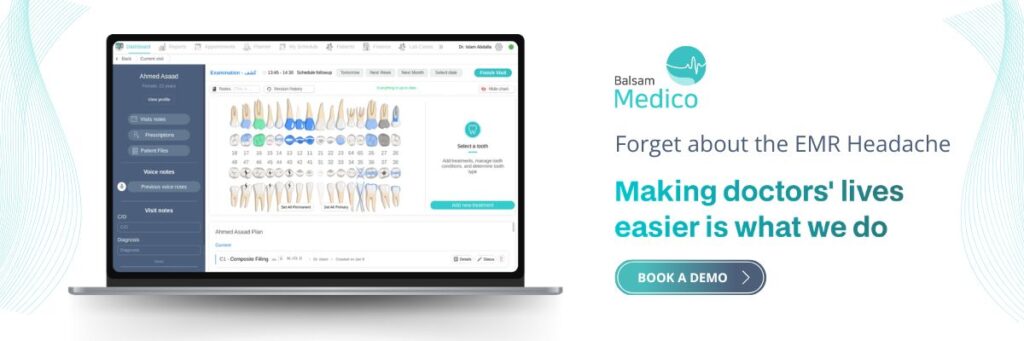
PS: We built Balsam Medico to be the best software for clinics in UAE and the middle east. It is powerful, flexible, and most importantly, very easy to use.
If you have two minutes, see how it works.
This is the main landing page to learn more.