Rayan Farouk
Ask ten clinic administrators in the UAE how VAT applies to their treatment list, and you’ll likely get ten different answers. Some assume healthcare is VAT-free across the board. Others charge 5% on everything to stay safe. Both instincts are understandable — and both are wrong often enough to trigger a Federal Tax Authority (FTA) audit.
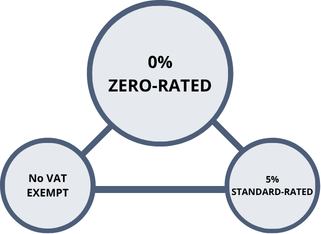
The truth is that UAE healthcare sits across three separate VAT categories, not one. A general consultation, a root canal, and a teeth-whitening session can all happen in the same clinic on the same day, and each one can carry a different VAT treatment. For billing teams, this isn’t a minor technicality — it determines what appears on every invoice, what a clinic can reclaim from its own expenses, and what an FTA reviewer will flag first if the numbers don’t add up.
This piece lays out how VAT works for UAE clinics in practice: the legal basis behind it, which treatments qualify for zero-rating, which ones sit at the standard 5% rate, and the gray areas that trip up even experienced billing teams.
VAT in the UAE, in plain terms
The UAE introduced Value Added Tax on 1 January 2018, under Federal Decree-Law No. 8 of 2017. The standard rate is 5% — modest by global standards, but the compliance obligations around it are not. Any business that crosses AED 375,000 in taxable annual turnover must register with the FTA, charge VAT correctly on every applicable supply, file periodic returns, and keep records the FTA can inspect on request.
Within that framework, every supply a clinic makes — a consultation, a filling, a bag of prescribed medication, a cosmetic filler — falls into one of three buckets:
| Category | What the patient pays | What the clinic can reclaim |
| ZERO-RATED | 0% VAT charged | Full input VAT recovery on related costs |
| STANDARD-RATED | 5% VAT charged | Full input VAT recovery on related costs |
| EXEMPT | No VAT charged | No input VAT recovery on related costs |
That last row is where most confusion starts. Zero-rated and exempt look identical to the patient — neither adds VAT to the bill. But for the clinic issuing the invoice, they are financially very different. A zero-rated supply keeps the clinic inside the VAT recovery system: every dirham of VAT paid on rent, equipment, consumables, and services tied to that treatment can be claimed back. An exempt supply blocks that recovery entirely. Confusing the two on a VAT return doesn’t just misstate a number — it either overstates a refund the clinic isn’t entitled to, or leaves recoverable VAT sitting unclaimed.
The reassuring part: true exemption is rare in UAE healthcare. The vast majority of core clinical work is either zero-rated or standard-rated. Exemption mostly shows up around specific financial and insurance-related supplies rather than clinical treatment itself.
The legal basis clinics are working from
Three pieces of legislation govern how VAT applies to a clinic’s treatment list:
- Federal Decree-Law No. 8 of 2017 — the core VAT law, which defines zero-rated and exempt categories under Article 45.
- Cabinet Decision No. 52 of 2017 (the Executive Regulation) — Article 41 specifically sets out the conditions under which healthcare services qualify for zero-rating.
- Cabinet Decision No. 56 of 2017 — governs the zero-rating of medicines and medical equipment, tying eligibility to registration with the Ministry of Health and Prevention (MOHAP).
Article 41 is the section clinic finance teams end up referring to most. It sets three conditions a service must meet to qualify for 0% VAT:
- The service must be generally accepted in the medical profession as necessary for treating the recipient, including preventive treatment.
- It must be supplied by a healthcare body, institution, doctor, nurse, technician, dentist, or pharmacy licensed by MOHAP or another competent UAE health authority.
- The recipient of the supply must be the same person receiving the treatment — in other words, the patient.
This is the one clinics most often overlook. If a company pays for a health package or occupational screening on behalf of its employees, the recipient of the supply is arguably the company, not the individual patient — which can push that supply into standard-rated territory, even though the underlying service looks clinical. Business-to-business healthcare arrangements need to be reviewed on their own terms rather than assumed to carry the same treatment as a walk-in patient visit.
What qualifies for 0% VAT
When a service meets all three conditions above — medically necessary, delivered by a licensed provider, and billed directly to the patient — it’s zero-rated. In day-to-day clinic terms, that generally covers:
- General practice and specialist consultations
- Surgical procedures to treat an injury, illness, or diagnosed condition
- Maternity and obstetric care
- Physiotherapy and rehabilitation, where medically prescribed
- Diagnostic services — bloodwork, imaging, MRI, X-rays — linked to a clinical referral
- Mental health consultations and licensed psychiatric services
- Preventive care, including vaccinations and medically indicated screenings
- Dental treatment addressing decay, infection, or structural damage (fillings, root canals, extractions)
Medicines and medical equipment carry their own zero-rating rule under Cabinet Decision No. 56 of 2017, separate from the service itself. A prescribed medication is zero-rated only if it’s registered with MOHAP, or imported with MOHAP’s permission. The same logic applies to medical equipment and devices — zero-rating is tied to the product appearing on an approved list, not simply to the fact that it’s used in a clinical setting.
This is why a clinic pharmacy can have two nearly identical products on the shelf with two different VAT treatments: one registered with MOHAP, one not.
What carries the standard 5% rate
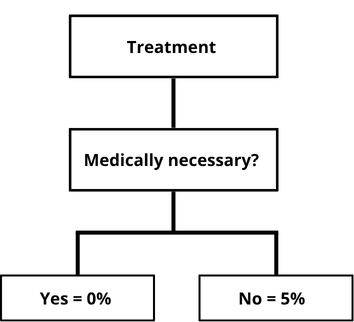
The moment a service falls outside “medically necessary,” it typically shifts to the standard 5% rate — even when it’s performed by the same licensed practitioner, in the same clinic, using the same clinical skill set. In practice, this covers:
- Elective and cosmetic procedures with no diagnosed medical basis — aesthetic injectables, elective rhinoplasty, cosmetic dermatology
- Teeth whitening and purely cosmetic orthodontics
- Non-prescribed retail products sold at the clinic — skincare lines, supplements, wellness merchandise
- Medicines and equipment not registered with, or approved by, MOHAP
- Administrative charges — medical report fees, records requests, insurance paperwork processing, missed-appointment fees
- Business-to-business healthcare services, where the recipient of the supply isn’t the patient
- Health and wellness services with no clinical necessity — some spa-adjacent or lifestyle treatments offered alongside clinical services
Notice what these have in common: none of them are being billed as treatment for a diagnosed condition. That’s the dividing line the FTA keeps coming back to — not the specialty, not the equipment, not even the practitioner’s license, but whether the specific service being billed was medically necessary for that specific patient.
The gray zone: same procedure, two different VAT outcomes
The clearest illustration of how fine this line gets is a procedure like rhinoplasty. Performed to correct a breathing impairment or structural injury, it’s zero-rated — it meets the “medically necessary” test. Performed purely for aesthetic reshaping, the identical surgical technique, by the identical surgeon, becomes standard-rated at 5%.
The same pattern shows up across several treatment areas clinics deal with regularly. Orthodontic work that corrects a bite dysfunction or jaw misalignment is zero-rated, while the same aligners or braces used for purely cosmetic straightening sit at 5%. A dermatology visit to treat a diagnosed skin condition is zero-rated, while resurfacing or anti-aging treatment with no diagnosis behind it is standard-rated. In each case, the procedure and the practitioner stay the same — what changes is the medical basis for doing it.
What separates a zero-rated claim from a standard-rated one, in every one of these pairs, is documentation — a clinical note, a diagnosis code, a referral, something in the patient file that shows the treating professional’s basis for classifying the procedure as medically necessary. If the FTA ever reviews a clinic’s VAT treatment on a specific line item, that record is what the clinic will be asked to produce. Billing teams that rely on the treatment name alone, without a documented clinical basis behind it, are exposed the moment a reviewer asks “why was this zero-rated?”
Where true exemption applies
Exempt treatment is the least common of the three categories in healthcare, and it’s worth clinics knowing where it does and doesn’t apply, precisely because it’s so easy to confuse with zero-rating. In the UAE healthcare sector, exemption shows up mainly around certain insurance and financial-service-adjacent supplies rather than clinical treatment itself — the financial mechanics behind a claim, rather than the claim’s clinical content.
Because both zero-rated and exempt supplies show “0% VAT” to a patient reading their invoice, it’s an easy distinction to lose track of internally. But for a clinic’s own VAT return, the two behave in opposite ways when it comes to reclaiming input tax — so a billing system that treats them as interchangeable will eventually misstate a return.
Why a single patient visit can generate three different VAT lines
Most UAE clinics — general practices, dental clinics, dermatology and aesthetics centers, multi-specialty hospitals — don’t operate in a single VAT category. A single patient visit can easily produce a mixed invoice: a zero-rated consultation, a standard-rated cosmetic add-on, and a zero-rated prescribed medication, all on one bill.

That mix is exactly what makes clinic billing more complex than retail VAT accounting. Each line on the invoice needs to carry the correct treatment on its own terms, and the supporting clinical documentation needs to justify that treatment if it’s ever questioned. A few implications follow from this in practice:
Invoicing has to work line by line, not visit by visit
A clinic can’t apply one VAT rate to an entire invoice based on the “type” of visit. Each service and product line needs its own classification, which means the billing system — and the staff entering charges into it — need a clear, consistent way to flag which treatments are zero-rated by default and which require a documented medical basis before they qualify.
Input VAT recovery depends on getting the split right
Clinics that mix zero-rated and standard-rated (and occasionally exempt) supplies need to apportion their input VAT recovery accordingly. Overclaiming input VAT tied to exempt supplies, or underclaiming what’s recoverable against zero-rated ones, both show up in an FTA review — one as a compliance risk, the other as a bottom-line loss.
Documentation is the clinic’s defense, not the invoice wording
An invoice that simply reads “rhinoplasty — 0% VAT” tells an FTA reviewer nothing about why that classification was applied. The clinical file — diagnosis, referral, treating professional’s notes — is what substantiates the treatment. Clinics that keep this documentation tightly linked to billing records are in a far stronger position if a supply is ever questioned than clinics that treat clinical notes and financial records as separate systems.
Retail and administrative charges need their own review
It’s easy for a clinic’s VAT setup to correctly classify clinical treatment while overlooking the retail and administrative side of the business — skincare products sold at reception, medical report fees, insurance processing charges. These typically sit at the standard rate regardless of how clinical the surrounding service is, and they’re often the line items that get missed during a VAT setup review.
VAT classification in healthcare isn’t a one-time setup a clinic completes and files away. Treatment lists change, new services get added, and the FTA periodically issues updated guidance and public clarifications that refine how existing rules apply. A treatment classified correctly two years ago is worth checking against current guidance rather than assumed to still be accurate — particularly for any service that sits near the line between “medical” and “elective.”
For clinic administrators and billing managers, the practical takeaway isn’t to memorize every category — it’s to build a habit: every new treatment added to a price list gets a VAT classification decision attached to it, backed by a documented clinical basis, before it ever appears on a patient invoice.
Where this fits into daily clinic operations
VAT classification touches billing, coding, and clinical documentation all at once — which is exactly where a connected clinic management system earns its keep. When treatment records, invoicing, and claims data live in one place, applying the correct VAT treatment stops being a manual judgment call on every invoice and becomes a consistent, auditable part of how the clinic already works.
Connect with Us
Ready to embark on this exciting journey? Contact us today:
📍 Dubai, United Arab Emirates – Tel: +971 56 640 9602
📍 Khartoum, Sudan – Tel: +249 91 273 1048
Explore Balsam Medico and discover a world of efficient clinic management at www.balsammedico.com. Together, let’s reduce fines, elevate efficiency, and embrace a new era of dental healthcare.
One last thing..
PS: We built Balsam Medico to be the best software for clinics in UAE and the middle east. It is powerful, flexible, and most importantly, very easy to use.
If you have two minutes, see how it works.
This is the main landing page to learn more.