Rayan Farouk
Opening a second or third clinic branch is an exciting step for any healthcare group. It means reaching more patients, growing the team and expanding the services available to different communities. But when those branches operate in different emirates, expansion comes with an additional responsibility: managing healthcare compliance across multiple regulators.
A clinic group with branches in Dubai, Abu Dhabi, Sharjah and other Northern Emirates cannot assume that the same regulatory requirements apply everywhere. Although all branches operate within the UAE healthcare system, each emirate has its own licensing authority, procedures and regulatory requirements.
A doctor licensed to work in one emirate may need a separate licence to practise in another. A facility’s approval process may differ depending on its location, and requirements for medical records, insurance claims, reporting and inspections may not be identical.
For clinic owners and group managers, this creates an important challenge. How do you maintain consistent operations across all branches without overlooking the compliance requirements that apply to each location?
The answer starts with understanding the difference between operating one healthcare group and complying with several regulatory authorities at the same time.
This guide explains how DHA, DOH, SHA and MOHAP fit into the UAE healthcare system, what multi-branch clinic groups should consider when expanding across emirates, and how to organise compliance without making everyday operations unnecessarily complicated.
1. Understanding the Four Main Healthcare Regulators in the UAE
Before discussing how to manage compliance across branches, it is important to understand what each authority does and where it applies.
The UAE healthcare system has a federal health authority and emirate-level regulators. Each has responsibilities for licensing, monitoring and regulating healthcare facilities and professionals within its jurisdiction.
Here is a simple breakdown.
Dubai Health Authority (DHA)
Regulates healthcare facilities and professionals in Dubai, subject to the applicable jurisdictional exceptions.
Official website: dha.gov.ae
DHA is responsible for licensing healthcare facilities, registering healthcare professionals, setting healthcare standards and monitoring the quality of services provided in Dubai.
For a clinic group operating in Dubai, some of the important responsibilities include:
– Obtaining and renewing healthcare facility licences.
– Ensuring doctors, nurses and other healthcare professionals hold the appropriate DHA licences.
– Meeting facility requirements and inspection standards.
– Following DHA policies for patient records and health information.
– Complying with Dubai’s health insurance and claims-related requirements where applicable.
DHA uses the Sheryan platform for many licensing and regulatory services. Clinic management teams use this system to handle facility and professional licensing applications and communicate with the authority.
An important consideration for multi-branch groups is that each branch must have the appropriate facility licensing arrangements. Sharing the same company ownership does not automatically mean that every branch can operate under one facility licence.
DHA does recognise facility groups in certain circumstances, allowing eligible healthcare professionals to rotate between branches under the applicable arrangements. However, this should not be confused with having one licence that covers every branch.
Department of Health – Abu Dhabi (DOH)
Regulates healthcare services in Abu Dhabi, including Al Ain and Al Dhafra.
Official website: doh.gov.ae
DOH is the healthcare regulator for Abu Dhabi. It oversees healthcare facilities, professionals, medical standards and the quality of healthcare services throughout the emirate.
For a clinic group with branches in Abu Dhabi, compliance responsibilities include:
– Obtaining and maintaining DOH facility licences.
– Ensuring healthcare professionals have the appropriate DOH licences.
– Meeting facility-specific clinical and operational standards.
– Following DOH requirements for medical records and patient information.
– Meeting applicable health insurance and claims requirements.
DOH uses the TAMM platform for a number of government services, including healthcare facility and professional licensing processes.
For example, opening a new clinic in Abu Dhabi involves obtaining preliminary approval and then progressing through the requirements for a permanent facility licence. The process also includes meeting the relevant facility and staffing requirements.
One important difference for clinic groups is the health information exchange system. Abu Dhabi uses Malaffi, which connects healthcare providers and allows authorised healthcare professionals to access relevant patient health information.
This means a group with branches in both Dubai and Abu Dhabi must consider the different health information exchange requirements that apply to each branch.
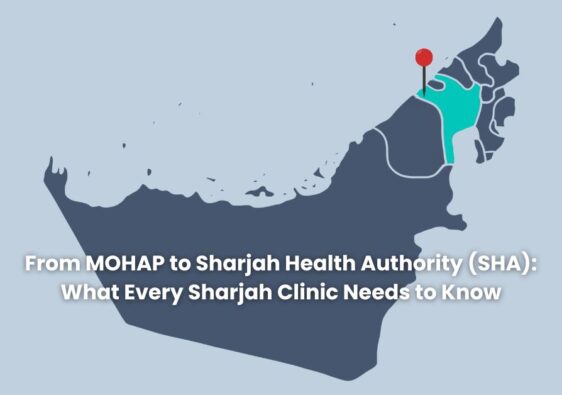
Sharjah Health Authority (SHA)
The emirate-level health authority for Sharjah.
Official website: sha.gov.ae
Sharjah has its own health authority, which is responsible for regulating healthcare services within its jurisdiction.
For a clinic group expanding into Sharjah, this means the team must identify and follow the relevant SHA licensing and operational requirements.
Some important considerations include:
– Facility licensing and renewal.
– Healthcare professional licensing and registration.
– Compliance with applicable facility and clinical standards.
– Inspection and documentation requirements.
– Health information management and applicable reporting obligations.
It is important not to assume that a DHA or DOH licence automatically authorises a clinic to operate in Sharjah.
There is also a distinction worth understanding: MOHAP maintains federal healthcare responsibilities and has service offices in Sharjah, but the existence of a MOHAP office does not mean that every Sharjah facility falls under MOHAP. The correct regulator should be confirmed for the specific facility and its licensing arrangement.
Ministry of Health and Prevention (MOHAP)
The federal health authority, with healthcare facility licensing responsibilities in the emirates and facilities under its jurisdiction.
Official website: mohap.gov.ae
MOHAP is the federal health authority and plays an important role in regulating and supporting healthcare services across the UAE.
For private clinic groups, MOHAP is particularly relevant to facilities in Ajman, Umm Al Quwain, Ras Al Khaimah and Fujairah that fall under its licensing jurisdiction.
Its responsibilities include:
– Licensing healthcare facilities and professionals under its jurisdiction.
– Reviewing facility requirements and conducting inspections.
– Ensuring healthcare providers meet applicable federal standards.
– Overseeing relevant healthcare services and regulatory requirements.
– Supporting the national health information system through Riayati.
MOHAP has its own digital services for facility licensing, including initial approval, inspections and final licensing.
For clinic groups operating in the Northern Emirates, Riayati is particularly important. It is the National Unified Medical Record platform, connecting healthcare providers and supporting the sharing of patient information between authorised providers.
Comparing the four regulators
The easiest way to understand the differences is to look at them side by side.
| Authority | Main jurisdiction | Health information exchange |
|---|---|---|
| DHA | Dubai | NABIDH |
| DOH | Abu Dhabi | Malaffi |
| SHA | Sharjah | Confirm applicable requirements |
| MOHAP | Facilities under federal jurisdiction, including much of the Northern Emirates | Riayati |
Remember that this is a practical overview, not a complete jurisdictional map. Special regulatory zones, facility classifications and individual licensing arrangements may create exceptions. Always verify the responsible authority before opening or transferring a branch.
2. Why One Healthcare Group Can Have Different Compliance Requirements
One of the biggest misconceptions among growing clinic groups is that having one company, one management team and one brand means having one set of regulatory requirements.
In reality, regulators focus on the facility and the healthcare activities taking place within their jurisdiction.
Consider this example:
A healthcare group owns four branches:
– Branch A in Dubai.
– Branch B in Abu Dhabi.
– Branch C in Sharjah.
– Branch D in Ajman.
The branches share the same ownership, management team, brand identity and general operating procedures.
However, their regulatory responsibilities are not necessarily the same.
The Dubai branch must follow its applicable DHA requirements, while the Abu Dhabi branch follows DOH requirements. The Sharjah branch must follow the requirements of its responsible authority, and the Ajman branch will generally fall under MOHAP.
This creates several differences in daily operations.
Professional licensing: A doctor working in Dubai may need the appropriate DOH, SHA or MOHAP licensing arrangements before practising at another branch. A professional licence should never be assumed to be automatically valid across all locations.
Facility licensing: Each branch must have the correct facility licence for its location, approved activities and services.
Inspections: A group cannot assume that passing an inspection in one emirate means every other branch meets its local requirements.
Patient information: Different branches may have different health information exchange onboarding and reporting requirements.
Administrative procedures: Applications, renewals, approvals and communication with regulators may take place through different government platforms.
The important takeaway is that a clinic group can have one overall business structure while maintaining separate compliance responsibilities for each branch.
This is why compliance should be managed at two levels: the group level and the branch level.
3. Professional Licensing Across Multiple Emirates
Healthcare professional licensing is one of the most important areas to manage when a clinic group expands.
A doctor, dentist, nurse or other healthcare professional must have the appropriate authorisation to practise at the relevant facility.
For example, imagine a dentist who works at a clinic in Dubai and is licensed by DHA. The group later opens a second branch in Abu Dhabi and wants the same dentist to work there twice a week.
The group cannot simply add the dentist to the Abu Dhabi branch schedule and assume the existing DHA licence is sufficient.
The professional must meet the applicable DOH licensing and facility-linking requirements before practising there.
The same principle applies when professionals move between branches in other emirates.
What should clinic groups monitor?
A central professional licensing register can make this process much easier.
For every healthcare professional, the group should maintain:
– Full name and professional designation.
– Licence number and issuing authority.
– Approved speciality and scope of practice.
– Licensed facility or branch.
– Licence issue and expiry dates.
– Required supporting documents and certificates.
– Any applicable restrictions or conditions.
It is also important to monitor expiry dates rather than waiting for a renewal reminder from the professional.
For example, if a doctor holds a DHA licence and a separate MOHAP licence, the two licences should have their own renewal records and reminders.
Can a professional work across different emirates?
In some cases, healthcare professionals may be eligible for licensing recognition or a simplified licensing process when moving between UAE health authorities.
However, this does not mean that a licence from one emirate automatically authorises practice in another.
The applicable Professional Qualification Requirements (PQR), verification documents, good standing requirements and licensing procedures must be checked with the receiving authority.
For clinic groups, the safest approach is to verify the professional’s eligibility before assigning them to another branch.
This avoids situations where a doctor appears on a branch schedule but does not have the correct authorisation to provide services at that location.
4. Facility Licensing and Branch Expansion
Opening a new branch involves more than finding a suitable location and completing the business registration.
A healthcare facility must meet the licensing requirements of the authority responsible for its location.
This includes requirements related to the facility’s layout, approved medical activities, equipment, staffing and operational readiness.
For example, a dental clinic opening in Dubai may follow DHA’s facility licensing process, while a dental clinic opening in Abu Dhabi must follow DOH’s process.
Even if both clinics offer the same services and use the same equipment, their approval processes and documentation requirements may differ.
What should be checked before opening a new branch?
Before signing off on a new location, clinic groups should confirm:
1. Regulatory jurisdiction: Which health authority is responsible for the proposed location?
2. Facility classification: Does the authority classify the facility as a general clinic, specialised clinic, medical centre or another category?
3. Approved activities: Are the intended medical services covered by the facility’s proposed licence?
4. Facility layout: Does the design meet the applicable requirements?
5. Equipment: Are the necessary medical equipment approvals and registrations in place?
6. Staffing: Are the required medical professionals available and appropriately licensed?
7. Inspections: What inspections or approvals are required before the clinic can start operating?
8. Digital systems: Does the branch need to connect to a specific health information exchange or other regulatory platform?
These checks should happen before the clinic begins treating patients.
A branch should never assume that an existing group’s approvals can simply be copied to a new location.
Why a central branch register matters
A multi-branch group should maintain one central register containing the licensing information for every facility.
This register should include the branch name, location, regulator, facility licence number, approved activities, issue date, expiry date and renewal status.
It should also include any additional approvals required for specialised services.
With this information in one place, management can quickly identify which branches need attention and which approvals are approaching expiry.
5. Medical Records and Health Information Exchange Requirements
Another important difference between healthcare regulators is how patient information is managed and shared.
The UAE has invested in connecting healthcare providers through national and emirate-level health information exchange platforms. These systems help authorised healthcare professionals access relevant patient information and support continuity of care.
However, clinic groups should understand that having one electronic medical record (EMR) system does not automatically mean that all branches meet their digital compliance requirements.
The system must support the relevant requirements for each branch.
Understanding NABIDH, Malaffi and Riayati
There are three major health information exchange platforms that clinic groups should understand.
NABIDH – Dubai
NABIDH is DHA’s health information exchange platform. It connects healthcare providers in Dubai and supports the secure sharing of patient medical information.
Clinics under DHA jurisdiction must meet the applicable NABIDH onboarding and integration requirements.
Malaffi – Abu Dhabi
Malaffi is the health information exchange platform associated with DOH Abu Dhabi. It connects healthcare providers and allows authorised users to access relevant patient records.
Clinics in Abu Dhabi must consider the applicable Malaffi requirements as part of their digital compliance responsibilities.
Riayati – MOHAP
Riayati is the National Unified Medical Record platform associated with MOHAP. It connects healthcare facilities and supports the exchange of patient information across the UAE.
Facilities under MOHAP jurisdiction must consider the applicable Riayati integration and reporting requirements.
These platforms are not completely separate systems that never communicate. In January 2023, the UAE health authorities announced the successful integration of Riayati, Malaffi and NABIDH. This supports the wider goal of creating a connected national medical record.
However, integration between platforms does not remove the individual compliance obligations of healthcare facilities.
For example, a clinic group may have one branch connected to NABIDH and another connected to Malaffi. Both branches still need to meet the requirements that apply to their respective regulators.
What does this mean for your EMR system?
A clinic group should choose an EMR system that can support its different regulatory environments.
The system should help the group manage:
– Patient medical records across branches.
– Appropriate access permissions for doctors and other staff.
– Required clinical documentation.
– Integration with the applicable health information exchange.
– Secure handling of patient information.
– Relevant reporting and data submission requirements.
The goal is to avoid having one digital system for Dubai, another for Abu Dhabi and a third for the Northern Emirates simply because the group has expanded.
A central EMR can provide a consistent working environment while supporting the different technical and regulatory requirements of each branch.
This is particularly useful when a patient visits more than one branch. The authorised team should be able to work with the appropriate patient information while following the applicable consent, access and data-sharing rules.
One system can support the group, but each branch must still meet its own regulatory obligations.
6. Insurance, Billing and Claims Across Emirates
Insurance is another area where multi-emirate clinic groups need to pay attention.
Although a group may use one billing team and one financial reporting system, insurance requirements can differ depending on the emirate, insurance scheme, payer and applicable regulator.
For example, a clinic in Dubai may deal with requirements associated with Dubai’s health insurance framework, while an Abu Dhabi clinic may work under Abu Dhabi’s applicable health insurance arrangements.
A branch in the Northern Emirates may have different payer agreements and claims processes.
This means the group should not assume that a billing workflow that works in one branch will automatically work in another.
Common areas that need attention
1. Insurance provider agreements
Each branch should have the appropriate agreements and approvals to provide services under its accepted insurance networks.
A group may have an agreement with an insurance provider, but the agreement’s scope should be checked to confirm which facilities and services are covered.
2. Claims submission
Claims must follow the applicable payer and submission requirements.
For example, a clinic may use eClaimLink for relevant Dubai insurance claims workflows, while other branches may have different payer or platform arrangements.
3. Billing and service codes
The group should ensure that billing practices, service descriptions and applicable codes are accurate and meet the relevant requirements.
4. Rejections and remittance advice
Insurance teams should monitor rejected claims, pending submissions and payment reconciliation.
5. Financial reporting
Management should be able to review revenue, insurance collections, outstanding claims and patient payments separately for each branch.
How can an EMR help?
A suitable EMR system should allow the group to maintain central financial visibility without mixing the operational requirements of different branches.
For example, management may want to see the total insurance revenue generated by all four branches.
At the same time, the billing team should be able to filter claims by location, payer, claim status and submission period.
This makes it easier to identify which branch has outstanding claims, which payer has delayed payments and where billing issues are occurring.
The important thing is to keep financial reporting centralised while maintaining the correct billing and claims workflows for each location.
7. Inspections, Documentation and Regulatory Audits
Compliance does not end once a clinic receives its licence.
Healthcare facilities must continue meeting the applicable requirements throughout their operations.
Regulatory authorities may conduct inspections, review documentation and assess whether the clinic is maintaining the required standards.
For a group operating across several emirates, this creates an additional management challenge.
Each branch may have different inspection schedules, documentation requirements and corrective actions.
What should be maintained at branch level?
Every branch should have an organised compliance file containing the relevant documents.
This may include:
– Valid facility licence and renewal documents.
– Healthcare professional licences.
– Medical director and facility management documents.
– Approved medical activities and service lists.
– Equipment maintenance and calibration records.
– Medical waste disposal agreements.
– Staff training and competency records.
– Infection control policies and procedures.
– Patient consent forms and medical records.
– Emergency procedures and safety documentation.
– Applicable health information exchange approvals.
The exact requirements will depend on the facility type and regulator.
Why central documentation is important
Imagine that a group has four branches and a manager is asked to provide the latest facility licence for the Abu Dhabi location.
If the documents are stored in different employees’ email accounts or on individual computers, finding the correct version can take time.
The situation becomes more difficult when several branches are preparing for inspections at the same time.
A central document management process helps the group maintain visibility over all important records.
Management should be able to identify:
– Which documents belong to each branch.
– Which documents are still valid.
– Which documents are approaching expiry.
– Who is responsible for updating them.
– Whether any inspection findings remain unresolved.
It is also important to assign responsibility. A central compliance manager can oversee the group’s overall position, while each branch manager ensures that local documents and procedures are maintained.
8. How to Build a Centralised Compliance Management System
Managing multiple regulators does not mean creating four completely separate management systems.
Instead, clinic groups should establish one central compliance framework with branch-specific requirements.
This approach makes it easier to maintain consistent standards while respecting the differences between regulators.
Here are five practical steps.
Step 1: Create a regulatory profile for every branch
Start by listing all branches and identifying their respective regulators.
Include the following information:
– Branch name and location.
– Regulatory authority.
– Facility licence number.
– Approved medical activities.
– Health information exchange requirements.
– Professional licensing requirements.
– Insurance and claims arrangements.
– Main renewal dates.
This gives management a clear overview of the group’s regulatory structure.
Step 2: Assign a compliance owner
Every branch should have someone responsible for monitoring its local compliance requirements.
This could be a branch manager, medical director or designated compliance officer.
The person should understand the branch’s applicable regulations and know when to escalate an issue to central management.
A central compliance manager can oversee all branches and ensure that important updates are communicated to the relevant teams.
Step 3: Standardise internal procedures
Although regulatory requirements differ, many everyday clinic procedures can follow the same internal standards.
For example, the group can maintain consistent procedures for:
– Patient registration.
– Medical documentation.
– Appointment management.
– Billing and payment collection.
– Staff onboarding.
– Patient consent.
– Complaint handling.
– Document storage.
However, these procedures should include additional steps where required by the local regulator.
A central procedure should never replace a mandatory local requirement.
Step 4: Monitor licence and document expiry dates
One of the simplest ways to prevent compliance problems is to maintain a central renewal calendar.
It should track the expiry dates of facility licences, professional licences, insurance agreements, equipment certificates and other relevant approvals.
Set reminders in advance so the responsible employee has enough time to prepare the required documents.
Do not rely on employees remembering renewal dates or waiting for the authority to send a notification.
Step 5: Review compliance regularly
Compliance should be reviewed throughout the year, not only when a renewal or inspection is approaching.
A monthly review can help management identify:
– Expiring licences.
– Missing documentation.
– Pending regulatory applications.
– Unresolved inspection findings.
– Staff licensing gaps.
– Digital integration issues.
– Changes in local requirements.
Regular reviews allow the group to address problems early rather than responding when an issue becomes urgent.
9. How the Right Clinic Management System Supports Multi-Emirate Compliance
Managing different regulatory requirements becomes much easier when the group has a reliable clinic management system.
Without a central system, each branch may end up maintaining separate patient records, appointment schedules, billing processes and operational reports.
This can create unnecessary administrative work and make it difficult for management to understand what is happening across the group.
A suitable EMR system helps bring these operations together while allowing each branch to follow its applicable regulatory requirements.
Here are some of the features that make a difference.
Centralised patient records
A centralised EMR helps maintain patient information in an organised environment.
Authorised healthcare professionals can access the information they need according to their roles and permissions, subject to applicable data protection and patient consent requirements.
This is particularly useful for patients who visit different branches within the same healthcare group.
Branch-specific access permissions
Not every employee needs access to every branch’s information.
A good clinic management system should allow management to assign permissions based on the employee’s role, department and location.
For example:
– A doctor may access the patients assigned to their branch.
– A receptionist may manage appointments and patient registration at their location.
– A cashier may access billing and payment information.
– A group administrator may have visibility across all branches.
This helps maintain a consistent management structure without giving every employee unrestricted access to sensitive information.
Integrated billing and financial reporting
A central billing system makes it easier to monitor the financial performance of the entire group.
Management can review revenue, outstanding payments, insurance claims and collections across different locations.
At the same time, branch-level reports help identify individual performance and operational issues.
Centralised appointment management
When patients can book appointments at different branches, having one organised appointment management system makes scheduling easier.
Staff can monitor doctor availability, manage appointments and reduce scheduling conflicts.
This also helps management understand patient demand across different locations.
Regulatory integration support
Perhaps most importantly, the EMR system should support the applicable health information exchange requirements for each branch.
For example, a group with DHA-regulated and MOHAP-regulated facilities should be able to manage the relevant NABIDH and Riayati requirements through suitable integration arrangements.
It is important to remember that purchasing an EMR does not automatically make a clinic compliant. The clinic must complete the required onboarding, approvals, configuration and regulatory procedures.
The system should support the compliance process rather than replace the clinic’s responsibility to meet regulatory requirements.
10. Common Compliance Mistakes Multi-Branch Clinic Groups Should Avoid
Even established healthcare groups can encounter compliance problems when expanding into new emirates.
Many of these issues happen because management assumes that the processes used by the original branch can simply be repeated everywhere.
Here are some common mistakes to watch out for.
1. Assuming one facility licence covers every branch
Each location must have the appropriate facility licensing arrangements. Shared ownership does not automatically extend one facility’s licence to another location.
2. Allowing professionals to work across emirates without checking their licences
A professional’s existing licence should not be treated as automatic authorisation to practise at another emirate’s facility.
3. Using the same compliance checklist for every branch
A general checklist is useful, but it should be adapted to the requirements of each regulator.
4. Overlooking health information exchange requirements
Having an EMR system does not mean that the clinic has completed all the necessary NABIDH, Malaffi or Riayati integration requirements.
5. Keeping regulatory documents in separate locations
When important documents are spread across emails, computers and individual folders, management may struggle to find the latest versions.
6. Waiting until licence expiry to start renewals
Late preparation can create unnecessary pressure and potentially disrupt operations if approvals are delayed.
7. Assuming regulatory requirements never change
Healthcare regulations, technical requirements and licensing procedures can be updated. Groups should regularly review official announcements and circulars from the relevant authorities.
11. A Practical Multi-Emirate Compliance Checklist
For clinic owners and group managers, the following checklist can serve as a starting point when reviewing compliance across multiple branches.
Group compliance review
Regulatory licensing
[ ] Identify the responsible regulator for every branch
[ ] Verify that every facility has a valid licence
[ ] Confirm that all approved medical activities are covered
[ ] Track facility licence renewal dates
Healthcare professionals
[ ] Verify professional licences for each branch
[ ] Check professional scope of practice and facility links
[ ] Monitor licence expiry dates
[ ] Maintain staff qualification and training records
Digital compliance
[ ] Identify applicable health information exchange requirements
[ ] Complete required EMR integration and onboarding
[ ] Review staff access permissions
[ ] Maintain secure patient records and appropriate consent procedures
Operations and finance
[ ] Review branch-specific insurance and payer agreements
[ ] Check claims submission and reconciliation processes
[ ] Monitor branch-level revenue and outstanding payments
[ ] Maintain equipment and medical waste documentation
Ongoing monitoring
[ ] Assign a compliance owner to every branch
[ ] Maintain a central regulatory document register
[ ] Schedule regular internal compliance reviews
[ ] Monitor regulatory updates and inspection findings
This checklist is a management tool, not a substitute for the full regulatory standards applicable to each facility.
Conclusion: One Healthcare Group, Different Regulatory Responsibilities
Expanding a healthcare group across the UAE creates opportunities to reach more patients and grow the business. However, it also means managing different healthcare regulators, licensing procedures and operational requirements.
DHA, DOH, SHA and MOHAP each have their own responsibilities, and clinic groups must understand which authority applies to every branch.
The key is to avoid treating the group as one facility from a compliance perspective. Instead, establish consistent internal procedures while maintaining separate regulatory records, licensing arrangements and digital requirements for each location.
A centralised clinic management system can make this process much easier by bringing patient records, appointments, billing, staff permissions and reporting into one organised environment.
With the right processes, a healthcare group can maintain consistent operations across all its branches without losing sight of the individual compliance requirements of each emirate.
At Balsam Medico, we believe that managing multiple clinic locations should not mean managing multiple disconnected systems. A well-organised EMR helps healthcare groups maintain operational visibility, simplify everyday workflows and support their growing compliance responsibilities as they expand across the UAE.
Connect with Us
Ready to embark on this exciting journey? Contact us today:
📍 Dubai, United Arab Emirates – Tel: +971 56 640 9602
📍 Khartoum, Sudan – Tel: +249 91 273 1048
Explore Balsam Medico and discover a world of efficient clinic management at www.balsammedico.com. Together, let’s reduce fines, elevate efficiency, and embrace a new era of dental healthcare.
One last thing..
PS: We built Balsam Medico to be the best software for clinics in UAE and the middle east. It is powerful, flexible, and most importantly, very easy to use.
If you have two minutes, see how it works.
This is the main landing page to learn more.